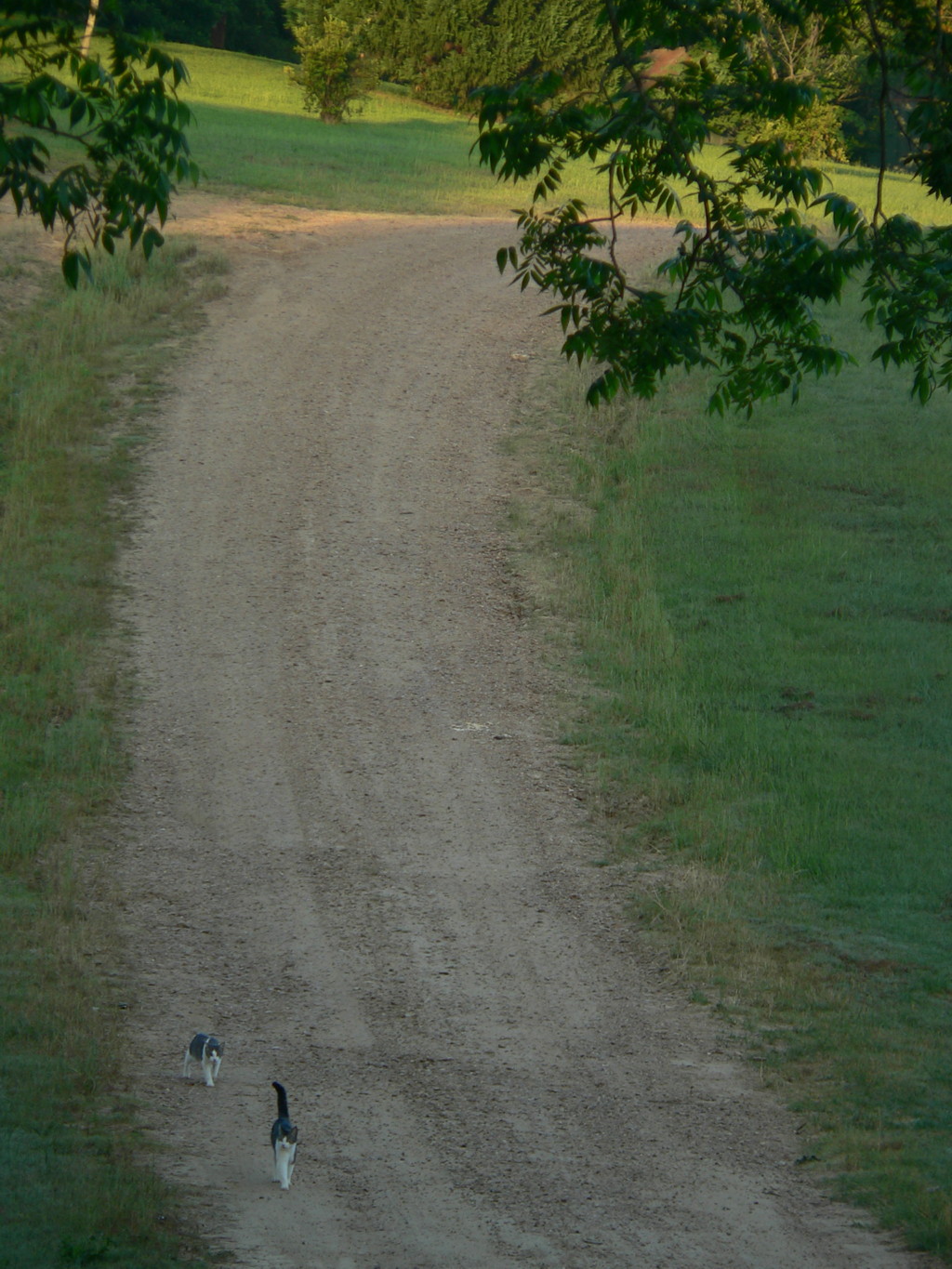
Monday, February 20, 2012

My personal photo album--computer files and Flickr account, that is--is full of weeds, or anyway, pictures of them. Flowers, too, and dogs and cats and trees and bugs and sunsets and sunrises and formations of migrating geese and a person here and there, but always lots of weeds.

Sounds pretty dull, I know. Who-in-hell takes pictures of WEEDS?

I suppose it’s all a matter of perspective.

A 7th-grade art class taught me one thing about “perspective,” or maybe one aspect of “perspective,” which, distilled, was basically that any particular thing you’re looking at gets steadily smaller as the distance between it and you increases. The art teacher had us make a pencil mark in the center of a sheet of drawing paper, then make marks equally apart on the left and right edges of the page, then make very light pencil lines from each of those marks down (or up, depending) from the marks on the edges, THEN draw something like a house or a box or anything with straight edges, like a supermodel for instance, within those faint gray pencil lines.

At the end of the exercise, we all could see how perspective “worked.”

Obviously an art teacher or an artist could explain this better than I can.

Three years later I took a photography “mini-course,” a 9-week class introducing me to photography, which gave me a whole different perspective on “perspective.”   In photography, “perspective” had more to do with the angle from which you chose to perceive a subject. So about every 9 weeks or so we would see a different crop of students climbing up on desks, lying prone on the floor, hanging from the transoms above the classroom doors with their cameras pointed down at the ordered or, more often, disordered rows of desks and student occupiers, etc., all looking for a “fresh” perspective on a “photographed 55 billion times” subject.

If it was eye-level to you, you needed to change the position of your eyes, of their height above the floor or ground--get closer to the floor, farther from it, didn’t matter; simply to alter your perspective was what mattered, that might make the image you capture “unique,” or at least different enough from the standard eye-level views to capture the attention of others.


A corollary to that was that you needed to try to seek out and “see from” the perspective of your subjects. If you’re taking a picture of a toddler, get down at eye-level with HIM, try to see the world through HIS eyes, rather than your own: A picture of the top of a toddler’s head is going to make most viewers yawn, at best; an eye-contact level view of a toddler toddling towards you is going to be at least a little more interesting.

What I somehow missed during this perspective lesson was the obvious.

Trying different perspectives can make the images you capture “better,” yes--but it can also change your own perspective, the way you view the world. This is not news, obviously.

I was thinking about all this today when I decided whimsically to go on a low-crawl along the fencerow at the south edge of my yard.

It was an hour or so before I had to go to work, the sun was shining, I was bored reading news and “sorta news” online, and I got to thinking about photography and angles and perspective and “quality of light” and on and on and on. I’ve only been doing photography on a more or less daily basis for maybe seven years now, although I’d toyed intermittently with film since high school (yea, “lo, these many years ago”), but somehow I’ve developed (groan) what a couple of friends call my “signature light.”

That’s not as artistically impressive a term as it may seem. Thing is, my work schedule as well as my personal preferences dictate that I take my camera out mostly in morning--and morning light IS magical.

Today I thought about it, and decided that, if it is true I have a “signature light,” maybe it’s time I tried something else.

Which led me to a low-crawl along the fencerow at approximately high noon (my least favorite light).

Lying on sun-drenched ground in mid February, in northwest Missouri, can be perspective-altering.

And when you actively seek something, generally you find it.

Today I found yet another weed. What made this one different was that it was only about 10 inches tall--this particular variety of weed usually tops out at about 4-5 feet, 5-6 times as tall as this little guy, a sort of “bonsai” among weeds of its ilk, and was inexplicably entranced by it.



I’ve only walked that fencerow with my camera maybe 100-150 times since onset of Autumn, and it’s not a long fencerow, the part that I walk being maybe 120 feet long. Yet until today, when I decided to do a low-crawl, I had never seen this particular brave little stunted weed.

Makes me wonder how much else I’ve missed, standing proudly up at eye level.

(And I still cannot figure out how to make the pic post "upright."  That is irritating.)

Monday, February 13, 2012

Mama please take my monochrome away.

Today was typically monochromatic for this time of year, the winter kind of day that we’ve been blessedly spared for most of this winter season. Coming off four days of semi-debilitating (that is, annoying more than anything else) back pain, despite the black-and-white and shades of gray coloring our world, it was nice to get outside, even nice to point the camera at something besides sunsets, sunrises, dogs, cats--the usual winter things you look for when the world seems otherwise without color.

I haven’t thought in black-and-white, really, in a lot of years, not since Tri-X Pan days, when I worked for a while as a sports photographer for a local newspaper, then as a photojournalist in the army. Once I left school and the army, I never did black-and-white again.

As a photographer I am more photojournalist (or photographic journal-writer) than artist, more interested in the “content” of an image than the image itself. That is not to say that photojournalists cannot produce art, or that photographic artists never produce excellent photojournalism. It really is a difference of approach, how you go about looking at potential “subjects” and even at that tool you carry in your hands and (when you’re lucky) begins to feel like a part of you, an extension not only of your eyes, but of your mind and heart, as well.

This means I take a LOT of pictures, some of them good, most of them ho-hum, some of them godawful. This also means that I have little time for “post processing” and other digital-darkroom manipulation of the images I “capture.” For the most part, that is not a bad thing, I think. My camera does a pretty good job at exposure and all that other stuff all on its own--while I COULD manipulate the image later, there is no real reason, most times, given that it is not the “image” I’m after, but rather more in the life captured IN the image, if any.

Which brings me back to monochromatic today, sort of.

Two of the dogs--Cecil and Nina--having charged off toward the back 40 or down to the river, the other one, Xena, lying comfortably in the snow, and the cats all inside, there wasn’t much at which to point the camera besides the black-and-white landscape, especially since, given the aforementioned back problem, I wasn’t able to get down and crawl around on the ground, etc.

And I began to see in black-and-white again.

It truly is a different way of looking at things. First, you look at shapes and patterns and lines, stuff defined not by color, but by, well, their shapes and patterns and lines. Then you look at contrast--you want black blacks, white whites, and as many of Ansel Adams’s “zones” in between as you can manage. The chisel-plowed field to the north, the chisel-plowed then anhydrous-drilled field to the east, along with trees in both directions, multi-shaded gray sky, all offered opportunity.

I looked and shot and shot and looked until my fingers were nearing frostbite (can’t manipulate a camera with gloves on, and it WAS cold), then came inside, plugged the SD card into the computer, inspected what I had.

“Muddy.” That’s a word we used to use to describe B&W photos that lacked those black blacks and white whites, but were instead only varying shades of gray. In “real” darkrooms back in the day, we could use “burning” and “dodging” and other tricks I’ve forgotten after my 30-something-year separation from trays of developer and rinse and fixer, smells of chemicals and thick black felt hung over doors, working under reddish light, watching images appear slowly, then leap into view on the sheet of paper you’re swishing slowly and methodically in each tray successively.

“Digital darkrooms” aren’t nearly as much fun, but they’re functional, and I admit I was even satisfied with most results. To be able to transform the image I saw on the computer monitor into something more closely resembling what I had seen through my own eyes . . . “Cool” only begins to describe it. And while the final product may be “boring,” I’m happy with it--especially because it reproduced what I remembered.

Trips down memory lane, back into a black-and-white world, can be fun, frozen fingers and all.

That said, I’m sticking with color and with my non-post-processing world. Call me lazy, call me a non-artist. It’s entertaining to visit sometimes, but the black-and-white world is no longer as comfortable for me as it was when I was 18 or 20 or 22. Figure that one out.

Wednesday, February 1, 2012

Come on, feel the noise.

I reintroduced music into the house the other day.

It had been pretty quiet around here for a couple of years, ever since I disconnected the one computer on which I used to download music videos because the computer had the misfortune of being located in the living room, which was then undergoing renovation, and started using this computer, the “play” computer in my office, for working with photos, everyday news-browsing, everyday EVERYthing.

I’d gotten used to the quiet, and in fact mostly enjoyed it. Once in a while I would miss being able to hear, as well as watch, news videos and so forth, but for the most part, it was as easy getting used to quiet as it was getting used to no television. I haven’t watched television in almost 10 years, not so much as a matter of choice, but because of my work schedule and the fact that I’ve lived in places where non-cable TV reception is almost nil. I still watch DVD movies at least a couple of times a week, but obviously have no clue what “Jersey Shore” might be, and wasn’t particularly heartbroken or even much affected by the demise of “All My Children” or “Seinfeld” or whatever. “Out of sight, out of mind.” Or, “Absence makes the heart go yonder.” Or something. And I’ve never gotten out of the habit of blasting music in my car on the way to the grocery store or to my parents’ house or even just on a sightseeing trip up on Pizz Ridge.

For no particular reason, this past weekend I decided that it was TOO quiet around here. It dawned on me that I should go ahead and re-hook up the computer on which I used to watch music videos, etc. THEN it dawned on me that, since the speakers on that computer were built into the monitor, all I really needed to do was swap out the monitors. Duh.

Yeah, I’m slow, but sometimes I get there.

The monitor swap worked, and now I have sound again--and when I pulled up Annie Lennox’s version of “Whiter Shade of Pale,” it hit me how much I’d missed it.

Since Saturday I have been a YouTube fool, seeking out long-”lost” (to me) videos, downloading and playing them. Free-associating took me from Annie Lennox to Bruce Springsteen to Madonna (and back again and again to Madonna) and to Starship and Neil Diamond and . . . The list goes on. Of course.

I didn’t stop with getting the sound back on the computer. THEN I went out and bought a portable radio/CD player. “Whole hog or none,” right?

Maybe I should have consulted my housemates before perpetrating these massive changes, however. The cats definitely are NOT fans of rock and roll, which is a bit surprising considering that at least two of them, as kittens, used to love it when I would plug in a movie with lots of gunfire, explosions and jet planes (think “Iron Eagle” and “Top Gun“), and absolutely despised anything “mushy” (think “chick flicks”).

Cecil the dog is put on instant, baffled alert by anything involving conversation (news clips, etc.), which again is surprising given that throughout his young life he has spent eight hours a day, five days a week in my office as I listen to dictated medical reports on speakers. On the other hand, he seems purely fascinated by anything involving Stevie Nicks (especially “Sara“ and “Gypsy“ and “Landslide“), and absolutely loves “Whiter Shade of Pale,” Madonna’s “Live to Tell,” and the “Jonathan Livingston Seagull” soundtrack.

Guess there’s no accounting for taste.

Tuesday, January 31, 2012

Virtuality

Sometimes I wish our corporate bosses knew as much about language as we do. Other times, I suspect that they know a whole lot more about language and its power than we will ever dream of knowing.

Years ago, maybe even now in places where people “go” to work--that is, someplace outside their home--a fashionable term to describe the people doing the jobs was “worker bees.” Think about that one. “Worker bees.” Not human, of no particular value, perfectly expendable, perfectly replaceable. Just so many tools. First time I heard the term in workplace context was in a (useless) meeting, spouted by some chick with an admittedly entertaining bust but not a whole lot else going on, at least “upstairs” (although I did come to admire the way she leaned over the conference table “just so.” On a clear day . . . ).

For the past 10 years I’ve been working at home, quite happily, an off-site “employee” of a medical transcription company. Today I’m in the same job, although the company I started with went through a couple of name changes, then a bankruptcy and acquisition by another, larger company, but still an “employee.”

Or anyway, I was.

Now, I’m a “virtual employee.”

Because I’m a fan of dictionaries and have spent many a glorious hour hopping from word to word in the “real” as well as the “virtual” variety, and even was once accused by an older cousin of reading the dictionary, I went in search of “virtual” in online dictionaries. Here is what I found in one:

Virtual:  adj.
1.  Existing or resulting in essence or effect though not in actual fact, form or name:  the virtual extinction of the buffalo.
2.  Existing in the mind, especially as a product of the imagination.  Used in literary criticism of a text.
3.  Computer science:  Created, simulated, or carried on by means of a computer or computer network:  virtual conversations in a chatroom.

Obviously, “virtual” has grown in meaning, even taken on a whole different meaning. Words do that sometimes.

So now “virtual” has acquired definition #3, above--“carried on by means of a computer.” Seems innocent enough.

Trouble is, for most of us in the medical transcription business, and maybe anybody over about age 20, the word still carries its original definition and nuance. See definitions #1 and #2, above.

It is no accident that our corporate bosses, all the MBAs of the world, the “bean-counters” and Republicans and so forth, have taken to calling us “virtual” employees. By doing so, they make us “unreal.” They dehumanize us, reduce us to . . . Who the hell knows how their minds work. Upshot of it is, it makes us ever so more easily disposable.

That they now comfortably refer to us as “virtual” means that they’ve already made us disappear, “virtually.” Those of us they cannot replace with computer programs--and computer programs aren’t yet all that good with words, although they are getting better all the time--they will replace with even less fairly paid Indians and Indonesians and I forget who all else. (It is mind-boggling or ironic or something to realize that, before too long, if I want to ply my trade for an American company, I’ll have to move to Asia. Nothing against Asia, but I would rather go to Romania, or Sweden--I know some crazy little women there, and they are HOT.)

Just makes me all proud to be an American.

I‘m really not whining about this. I‘m more Darwinist, I suppose, than anything else, albeit with a strong humanistic streak, and I know that “life is unfair,” blah blah blah. I‘ve never even been ON a turnip truck, much less fallen off of one.

It does strike me, though, that we are about to “telephone-game“ our way into extinction.

Capitalism, free enterprise . . . That worked a century or two ago, when we had lots of space and not a whole lot of people. Capitalism, free enterprise, the “American Creed,” have been passed down from one generation to another over several generations, losing a little something with every passing of the proverbial baton, yet in some important ways never really changing. Its latest transmogrification will impoverish more Americans than it will ever enrich.

What scares me, I think, is the suspicion that America, and Americans, have lost their vision, have lost their dream.

“When you give up your dream, you die,” said a character in a movie, “Flashdance.”

I look at myself and realize that I have become nothing more than a “virtual employee,” and see that I am dead or dying, and by extension, America is dead or dying.

Monday, January 30, 2012

Learning

Your memory and the way your mind works, combined with a situation, can take you down some odd pathways sometimes. For instance, the other day I was out pointing my camera at frost-covered weeds along a fencerow when it occurred to me that my habit of pointing my camera, with macro lens, at frost-covered or dew-dripping weeds along a fencerow has probably made me better at my job as a medical transcriptionist or medical editor/transcriptionist or “medical language specialist” or whatever title they are conferring on us in lieu of actually fair pay--and conversely; that is, my job has made me better at seeking out subjects for macro photography. In both, attention to detail, looking at the “small” things, is (thinking of various clichés, here: “paramount,” “key,” “the ONLY thing,” etc.).

A little over a decade ago, I left a job in a busy pediatric clinic at a teaching hospital where I had worked for a little over a decade. In many ways I hated leaving--it was a decent enough job, but, more importantly, had transformed me in myriad, mostly unexpected ways. For example, it even made me a better driver. Spend a few years walking rapidly through a clinic with three waiting rooms and a couple dozen exam rooms boiling over with bored and/or hyperactive and/or just plain normal, active kids, and you sharpen your peripheral vision--nobody wants to slam into a 4-year-old who has barreled out of a waiting room into the hallway. That enhanced peripheral vision saved me from barreling into stop sign-ignoring cross traffic on the commute to and from work on at least three occasions that I specifically remember.

In that particular job I worked for 7-10 pediatricians, 4 nurse practitioners, and sort of for 2 social workers, plus had to deal with 50-something residents and every-two-month rotations of medical students, all with their own personalities, obviously. That probably doesn’t seem like much, but to introverted-me, it was a lot, or seemed to be whenever I thought about it (which wasn’t often). One of the nurse practitioners once told me that my job was like being married to a dozen women at a time, which made me laugh because she was so right.

That probably prepared me to handle up to 21 pets (16 cats, 5 dogs) at once--and handling/keeping happy 21 pets at a time probably prepared me for my current job, to some degree. It helped teach me how to pay attention.

Which in turn helped me when I relocated to Natchez, Mississippi--”Deep South”--a few years ago, then when I relocated back up here almost 3 years ago.

I am not a “perfect” photographer, macro or otherwise, was never a perfect office coordinator, will never be a perfect transcriptionist or editor or driver or pet-slave or even neighbor or anything else, but it can be fun to look at how all of those separate “parts” of me have meshed and fed off each other, learned from each other, over the years.

Point is, we all get our “real” education in circuitous and unexpected ways.

This is not news, I know--we all know that we can and do learn from every situation we experience and every person we meet. Sometimes we may need to remind ourselves of that, however.

Monday, January 23, 2012

"I got a Nikon camera, I love to take photographs . . ."

Was reading a while ago about Kodak’s bankruptcy filing and the demise in general of traditional, film-based photography. Almost more interesting than the story itself were the comments readers made, which ranged basically from “they just couldn’t keep up with progress, serves them right” to “film was SO much better than digital! It will come back, like vinyl records.”

As a hobbyist photographer whose original best friends in the field were Kodak Tri-X Pan black-and-white film (for high school, college, newspaper and army journalism assignments), Kodacolor and Kodachrome for more personal projects, but who went digital seven years ago and hasn’t looked back, I can see both sides. Sometimes I miss Kodachrome, especially (and still love Paul Simon’s “Don’t Take My Kodachrome Away.” Best opening line EVER: “When I think back on all the crap I learned in high school/It’s a wonder I can think at all”). Of the thousands of photos I’ve taken over the past 30-something years, some of my favorites still are prints made from Kodachrome slides.

But I became a better photographer (maybe not good yet, but working on it) with digital simply because it allowed me the luxury of endless repetition: Once you buy the camera and the computer, you’re done spending (unless you get prints made, which I’ve been known to do). I pressed the shutter button on my first digital camera, a Lumix FZ20, almost 90,000 times, pointed the camera and focused on a subject probably 300,000 times, before I retired it. Practice has not made me perfect yet, but still the practice has been invaluable. If nothing else, I’ve learned to see light itself in a whole new (to me) way.

And the digital format allows me to “share” photographs through on-line media like Flickr, which in turn has given me the opportunity to meet other hobbyists (and pros) from all over the world. Compared to showing photo albums or slide shows to whomever you can lure into your physical presence, this alone is amazing. One of the fringe benefits of that aspect is that, with your pictures on line, you don’t even have to be there to show them to other people--they can happen onto your photo stream, wander around, look at a few, enjoy them (you hope); then, later, you see what they’ve looked at and are able to revisit images you might have forgotten (like the one I’m going to attach to this post, if I remember).

In the article I read this evening about Kodak’s bankruptcy, the writer quoted a “commenter” on an “Atlantic Monthly” story about same. The commenter wondered if, in 100 years, any of today’s digital images would still be accessible. He had prints from 19th century photos, he said; would any digital images survive? Good question. I’ve asked myself the same thing.

Technology changes so rapidly, will files we’ve backed up on external hard drives, etc., even be able to be read by computers of 10 years from now, or 20? Or two?

The hope, I suppose, is that Flickr and Photobucket and whatever other on-line photo storage companies are out there truly mean it, and, more importantly, believe it, when they tell us that what we store with them is “forever,” that the 37,000 pictures I’ve got on Flickr so far somehow will be available to me when I’m in my dotage (not that far down the road) and to anybody else who cares to look at them, long into the distant future.

My best guess, of course, is that none of it is “permanent,” that Flickr, et al, ultimately will die or fade away or otherwise disappear, and along with them the millions or maybe billions of images from all over our world, the daily photographic record of millions, maybe billions of people.

And that is probably as it is supposed to be.

Across the road from me is a very small, old cemetery. Nobody around here now knows anything at all about the people buried there, who died between 1870 and 1901, really not that long ago.

In the long run I suppose it doesn’t matter. Life goes on, the world goes on, one way or another.

But . . . Wouldn’t it be SOOOO very cool for, say, whoever lives in this house or on this property 300 years from now to be able to pull up my 21st-century photo stream and see real life fin this particular spot rom that long ago? Wouldn’t it be SOOOO very cool to be able to “see” history, to see the world, as it unfolds or grows on a day-to-day basis?

Good night, Kodak, wherever you are . . . .

Monday, January 16, 2012

There's a bathroom on the right.

Doubt that John Fogarty and Creedence Clearwater Revival, or even the songwriters themselves (Eddie Miller, Dub Williams and Robert Yount--credit where credit is due) ever imagined a young Missouri farm boy listening to “Bad Moon on the Rise” and hearing inexplicably a line about a “bathroom on the right.” That’s what I heard, though, for years, probably well into my thirties, every time that song came on the radio and even when I put the actual vinyl record on the turntable. It never made any sense to me, but then, a lot of rock lyrics never made “sense,” per se. (Can we say “doo wa diddy diddy dum diddy do”?).

Probably everybody can remember their own personal “misheard lyrics.” My ex-wife’s, for instance, was “It’s so scary,” which was how she and her sister always heard til Tuesday’s “voices carry.”

And then there are mispronounced words--read as well as spoken. In sixth grade our reading teacher read “Great Expectations” to us, and about every third or fourth word seemed (to me, at least) something that sounded like “melon collie,” as if a fat Lassie had somehow inserted herself into the story. It wasn’t until I got hold of a copy of the book that I discovered that the “melon collie” was what I had been “hearing” in my head as “ma-LAN-cha-lee,” spelled “melancholy.”

I thought about “ma-LAN-cha-lee” tonight when I was transcribing a “history and physical” dictated by an ESL physician whose English is actually pretty good. When he got to the medication list, he mentioned something that sounded like “ma-LAT-a-neen.” I’d gotten pretty much everything he’d said up to that point without much trouble, despite his accent, but ran into a wall on that one. I went to the FDA site and plugged in about every 3-letter combination I could think of, still could come up with no likely possibility. I gave up, inserted a blank, then before sending the report, re-listened to it and went through some other mental gyrations that I won’t even try to describe, and finally it clicked: He was talking about “melatonin.”

Language can be slippery, as much for the speaker as for the listener.

Listening to dictated medical reports sometimes can be like looking at one of those “magic pictures” that at first glance (and second, third, fourth, etc.) seem like just a multicolored, psychedelic yet organized splatter, then morph into a 3-dimensional image.

Sometimes it is like one of those “tip-of-the-tongue” moments when you can almost grab the word you’re looking for, but not QUITE. It’s like you hear it for one infinitesimal fraction of a second, then it gets away, lost in a blur of sound, surfacing fleetingly and tantalizingly just out of your audio “reach,” like a dolphin’s fin appearing and disappearing and reappearing in successive flashes amid the ocean waves.

And sometimes it is like an audio kaleidoscope, one of those little tubes that you hold up to your eye, peer into and see bits of colored glass forming one symmetrical pattern at the other end, then you give the tube a quarter-twist and the bits of glass reform into a completely different, yet still symmetrical pattern.

It’s like hearing “there’s a bathroom on the right” perfectly clearly, then giving the tube a quarter-twist, and suddenly hearing “there’s a bad moon on the rise,” also with perfect clarity--only now you will never be able to listen to the same song, same artist, and hear “there’s a bathroom on the right,” ever again, just as you would never be able to “un-see” the 3D image hidden in that psychedelic magic picture puzzle once you actually saw it.

Don’t get me started on how “black” and “white” can be virtually indistinguishable to the ear.

Wednesday, December 21, 2011

"I wanna be ELECTED!"

I will admit that I pay less attention to the quadrennial presidential frenzy than I probably should. While I can name most (probably not all--how many of them ARE there?) of the GOP candidates and all one of the Democratic candidates, and while I’ve read countless news accounts and editorial discussions in the aftermath of the endless debates among the former, I still cannot pin down exactly why any of them chose to throw their hats into the proverbial ring. Why does Michele Bachmann want to be president, for instance, aside from “God told me to do it”? What does Rick Perry see himself as offering the country? Or baseball-glove out of Massachusetts, or the now nearly forgotten pizza guy, or salamander-serial-adulterer, or Ron “Methuselah was a KID” Paul. I admit I kind of like the Utah Mormon, Huntsman, but that may be as much because his daughters are a hoot as anything else.

I would love to ask every one of them, in a quiet, non-photo-op moment (if there were such a thing), WHY they, personally, not only want the job, but deem themselves qualified for it. Like that moment in the movie, “Blind Side,” when Michael turns the tables on the NCAA investigator, telling her that they want to know why everybody else wants him to go to Ole Miss, but not why HE wants to go there.

Why whatever percent of voters want Paul or Bachmann or Romney or Perry or Cain or Huntsman or whomever to become president (which mostly boils down to “anybody but the black guy” anyway) doesn’t interest me nearly as much as why that handful of people each individually want to become president.

Frankly, I sense that none of them really want the job.

Running for president has become less about becoming president, than merely the lucrative game of running itself. Heck, just tagging along as the vice-presidential candidate four years ago made Sarah Palin rich. She didn’t even have to bother going back to her original day job as Alaska governor. She has demonstrated that there are almost as many perks to being a presidential candidate, in however teasing a way, as to the job itself--plus none of the headaches.

Ron Paul apparently gave up his medical career to become a career politician and then a career presidential candidate. Near as I can tell, he “consistently” stakes out positions that will keep him “interesting” and “attractive” to just large enough a portion of the electorate to make him seem viable as a candidate, but not to large enough portion of same to make him actually likely to be elected.

It’s not the job, it’s the adventure, and the money and publicity that flow along with it.

As my own job seems threatened and my “career,” such as it is, in doubt, I’ve begun thinking about other lines of work. Running for president is starting to look like a pretty cool opportunity, and it’s not like I haven’t thought about it before. Back in the 1970s, here in Missouri, we had a guy run for governor, “Walkin Joe Teasdale,” who got the name because he actually perambulated on foot around the state, and eventually managed to beat the incumbent governor, Kit Bond, who came back to beat Walkin Joe four years later. I was in high school at the time, given to daydreams (always better than algebra or geometry), and one day I wondered what would happen if an 18-year-old Midwestern kid started walking across the country, announcing himself as a presidential candidate for the election 17 years hence. He could work odd jobs, talk to people, generally spend 17 years getting his name out. People would KNOW him, or think they did, and he would know people, his eventual constituency.

I never got much further with the story than that, but now I wonder.

Could there BE a better job than running for an office you know (and hope and pray) you’ll never win?

Guess you’ll have to ask Ron Paul or Sarah Palin or Mitt Romney or Newt Gingrich or . . . Whomever. Don’t ask B. H. Obama, though--he tried to pull off this “running” thing and actually won, much to his apparent chagrin and dismay.

VOTE MEDIAN PERSPECTIVE IN 2020!

Saturday, December 17, 2011

New Years Resolutions

About 147 years ago, give or take, I decided to start keeping a journal.

While it wasn’t a New Year’s Day or New Year’s Resolution sort of thing, I did set some ground rules for myself. Number One was that I would NOT waste journal space and writing time just bitching about stuff. The journal was going to be at best positive, at worst, blah, but never negative.

Somehow I managed to keep that journal for several years, before I got tangled up in e-mail (and convinced myself that that was a reasonable substitute) and chat and god knows what else, and somehow, I managed to stay true to the resolution to stay positive.

I wrote about tiny little kindnesses people had shown me, any given day--and there were a LOT of them, like the nurse telling me how proud she was of me for not smoking in my office on the day our hospital went smoke-free, or my doctor-boss walking to the lunchroom with me, just chatting casually about our everyday lives, people saying “thank you” or giving me a smile or just sharing part of themselves with me. There were unimaginable moments like one sparkling January day when the temperature magically climbed to 70 and people were stretched out on park benches just soaking up sun, and one March day when I went for my lunchtime walk and ran into hard-blowing snow and leaned against a tree for just a moment, and just for that moment felt so incredibly ALIVE, and there was the total solar eclipse and people all over “Hospital Hill” coming outside to watch--and the nurse poking a hole in a little piece of cardboard and projecting the eclipse on the floor for some patients who could NOT go outside.

I wrote down conversations that resonate with me even now, mostly little simple things, little simple moments, that somehow made me “connect” with other people in ways I had never imagined possible.

I wrote down LIFE. And it was cool.

Maybe it doesn’t qualify as a “New Year’s Resolution,” given that I started the journal in October. I could lie and tell you that I started it on January 1, but what would be the point of that? Writing the journal started with a resolution; it was my New Year, at that point in my life.

I’ll curse AOL for leading me away from it later. Or not.

Wednesday, December 14, 2011

Methane, the God particle, and the axis of evil.

Interesting news day . . . .

In one corner of our world, physicists playing with the giant atom smasher in Europe announce that they believe that they are getting tantalizingly close to finding the Higgs boson, aka “The God Particle.” I know nothing of physics, but gather that this subatomic particle would prove the scientific view of the universe and how it was born. Hence, “God” particle.

Meanwhile, a Russian scientific survey team studying methane emissions off the northern (Arctic) coast of Siberia were shocked and astonished, perhaps even awed by the scale, volume and force of methane being released into the atmosphere. Apparently enough ice has been melted and permafrost thawed that thitherto captured methane has begun to escape its earthly bounds much faster than anyone had even feared, with the potential to spur global warming to “runaway” state--with what one headline (couldn’t find the reference in the article) claiming possible “dramatic” climatic change in as little as a year.

Methane release. Basically, the earth farts, and we’re all suddenly history (or rather, pre-history to any civilization that springs up here thousands of years after we fade to dust). That would be an act of flatulence more impressive even than what we have spewing out of Washington, DC in this election cycle.

So on one hand we have scientists on the verge of unmasking God, and on the other, a discovery that could mean the end of life as we know it, much sooner than anyone had dreamed or nightmared.

Now, I’m sure that’s just a coincidence. Still . . . Maybe God would rather not be unmasked.

Fast forward to today (yes, world events move quickly), and an opinion piece over on CNN tells us that the world should prepare for a “near nuclear” Iran. Of course, for those of us who came of age during the Cold War, that conjures up disturbing images of “Nuclear Winter” and all the misery accompanying that.

And suddenly it occurred to me that we do in fact hold the key to stopping global warming in its tracks.

Should Earth’s arctic farting indeed lead to runaway global warming, how about a tactical nuclear strike (or a few) to counter the life-threatening climatic catastrophe with its potential equal? Would nuclear winter trump global warming? Would they battle to a cosmic standoff, allowing at least some of humanity to survive?

Most of the problems of our world, obviously, are born in the northern hemisphere--obviously we would start here.

Smarter people than I, along with computer models and such, would have to plan specific targets, but I humbly suggest that we start with the “axis of evil”--no, not Iraq, Iran and North Korea. That is so Bush! I’m talking about the REAL axis of evil: Washington, Wall Street, and Hollywood. That fits nicely with our cultural preference for “trinities,” as well. Nuke them, plunge the northern hemisphere into nuclear winter, and global warming is solved!

Of course, that will never happen--by human design, anyway. It’s one thing for the U.S. president to sacrifice New York City in exchange for having accidentally destroyed Moscow, a la “Fail Safe,” quite another for heads of state in the top half of the world to agree to sacrifice themselves and their citizenry for the greater good of humanity.

Intriguing thought, though. Maybe I should pitch it to Hollywood as a “reality show.”

Friday, December 9, 2011

Cabbage and the Antichrist

I’ve been giving the Antichrist, specifically the car accident variety, a lot of thought today.

On a report one of my coworkers edited today, our speech recognition program had translated a patient’s chief complaint of “I was in a car accident,” as “I was in a car antichrist.”

First question that springs to mind, of course, is “why would a medical program even KNOW the word ‘antichrist?’” I understand that thousands of words were programmed into these systems, and obviously that each individual word could be looked at critically to judge whether it deserved to take up space in the program’s vocabulary--how likely would it be for the word to appear in a medical report? So there will be a lot of superfluous words, words the system “knows” but will never likely use, in its vocabulary, as is true for most of us speakers of a language.

Still . . . . My computer desktop occasionally tells me that there are unused icons on my desktop, do I wish to dispose of them? I would think that, given what I understand to be the fact that speech recognition programs depend on complex mathematical probability models and so forth to make its decisions concerning “le mot juste” in any given context, after producing thousands of documents I would think the program would begin periodically purging itself of the clutter of thousands of words it never, ever uses, or so very rarely that it’s not worth holding onto, if only to avoid embarrassments like calling an accident an antichrist.

We are told that these speech rec systems “learn,” and it’s true, to some degree. But we are also supposedly able to “teach” them. One of my favorites from the medical world is CABG, the acronym for “coronary artery bypass graft.” That particular acronym appears in a significant percentage of reports I transcribe. Speech rec invariably (so far) reproduces it as “cabbage.” The way the system’s “learning” theoretically operates, if “cabbage” gets edited to “CABG” three consecutive times, the system will forget all about cabbage and stick strictly with the bypass. Unless there are a lot of medical transcriptionists out there who REALLY think the heart surgeon is talking about a coleslaw ingredient, the system just cannot grasp acronyms pronounced as words (CABG is pronounced cabbage. Nobody ever says C A B G--if they did, the system doubtlessly would get it).

But I still halfway expect to see, come March 17, a flurry of speech rec produced reports of ER visits all over the country concerning some poor wretch, maybe even the Antichrist, who choked on his “corned beef and CABG.”

Similarly, the same system that invariably spells “Advair Diskus” as “Advair Discus,” come track season or the Summer Olympics, start reproducing lines like, “The spectator unfortunately was hit by a flying Diskus.” “Discus” probably appears in medical reports with approximately the same frequency as “cabbage,” after all.

Getting back to the Antichrist, maybe it’s only that speech rec is developing an ego and wants to autograph its work once in a while.

Thursday, December 8, 2011

Sunset maunderings at 1:30 a.m.

Mama always taught us that, if we didn’t have something nice to say, we should not say anything at all. (Is there anybody in the world, outside of politics and the internet, whose mama didn’t teach them the same?)

So for nearly 53 years I’ve mostly tried to avoid commenting on Winter.

Late this afternoon I was standing outside in the mild cold--it wasn’t the “take-your-breath-away” variety, just standard December right-around-freezing--admiring the sunset while Xena the old dog rolled in the grass (she has a thick coat and positively loves the cold) and Cecil, the half-yearling beagle/boxer mix chased Nina, the “middle-aged” part-chow, across the deeply furrowed fall-plowed field west of the house.

I work an odd split shift, most days--11:30 to 3, then 5:30 to 10--and so I grab sunsets whenever I have the chance. Most of the year, that means only on Fridays and Saturdays, my days off; rest of the week, I may steal a fleeting glimpse of the “reverse” sunset, the view to the east, through a crack in the curtains.

Sunset this afternoon wasn’t particularly spectacular. Clouds on the horizon and overhead bore promise that the sun’s fading slanting light could make it spectacular, and that wispy promise kept me out there with my feet turning numb and the (mild) cold starting to seep through the goose-down filling of my coat. Finally I did have to come back inside and thaw out--work beckoned, after all--but the little while I was able to spend out there, hoping for spectacular . . . Well, it’s all about hope, isn’t it?

When winter starts settling in, I dread the cold, of course, but most of all I dread the lack of light. Probably I am no more or less prone to SAD--seasonal affective disorder--than anyone else, but the decrease in hours of light definitely depresses my “inner photographer.”

It occurred to me today, though, and not for the first time, that the sun setting earlier means I get to enjoy sunsets on a regular basis for at least a few weeks. While I’m still more of a fan of sunrises, I have to call that a “win” for winter.

So, to my mother--I can finally say something “nice” about this godawful frigid miserable useless depressing and generally crappy time of year! You did your job well, Mom.

Here, have a sunset:

Wednesday, December 7, 2011

Too lazy and/or brain-dead to write, right now.

From the “if I ever say/write anything that cool, I’m going to shut my mouth forever because I’ll never be able to get there again“ file:

“I learned to make my mind large, as the universe is large, so that there is room for paradoxes.” Maxine Hong Kingston, “The Woman Warrior.”

Enough said, for now.

Tuesday, December 6, 2011

Wondering what the climate is like in Tibet . . .

A woman in a Facebook group for medical transcriptionists/editors on our particular team posted this today: “There is no need for temples, no need for complicated philosophies. My brain and my heart are my temples; my philosophy is kindness.--Dalai Lama.”

I love the quote, know virtually nothing about Dalai Lama, although of course I know the name, but it got me restarted wondering some things I’ve been wrestling with for a while.

Useless things, mostly: For instance, what if we all just bailed out of the “corporate world,” quit working for them, quit buying their products, etc. Obviously that is an impossible idea--we all have to work, we all have to eat, and our consumption is the driving force of two-thirds or thereabouts of our nation’s economy. It might make us FEEL all “fuck you” and so forth, but we would be shooting ourselves in the foot, or maybe in the heart.

Still . . . .

The notion of simplifying our lives, learning to live inside the temples of our brains and hearts, can be tantalizing. Who wouldn’t want to dispense with all the BS, all the daily rush (or the daily monotony, depending on what you do for a living), the daily nightmare or daily recalcitrant pain of just trying to make it from one day to another?

Life can be so fatiguing, sometimes, and it really shouldn’t be.  Exhausting, yes--exhausting can be a good thing. But fatiguing? Whole ‘nother thing. Life should be glorious. And in fact it is.

“Exhausting” is an exhilarating workout; “fatiguing” is a wear-you-down-to-nothing grind.

There is probably not a person in this country, maybe even in the world, who does not wish, at some point or other, that s/he could simplify his/her life, step off the treadmill, quit simply (or simply quit) worrying so damned day-to-day MUCH about whatever their hearts/minds are really “about.”

There is probably not a person in this country, maybe even in the world, who doesn’t wish that s/he had the luxury of simple time--even just a worry/stress-free hour to spend daydreaming, or watching cats or dogs or bugs or other people. A worry/stress-free hour just to relax.

We spend our lives in a continual state of tension, a continual state of competition, one way or another. Working at home alone, I’m spared some of that, though obviously not all. Most medical transcriptionists, even when employed by companies, are paid by what they produce, not by the time they put in. When you’re an employee, you are in fact limited to 40 hours a week. What this means is that, if you want to make a living at it, every day when you sit down at the keyboard, you have to make every minute count. It’s continual tension because you have to be aware of the “real” cost of every interruption or distraction--a 15-minute chat with a neighbor, for instance, costs you, say, a couple of loaves of bread or a pound of ground chuck. The clock ticks while you chat, and you can never get that time back. (May be a bad example: Sometimes a 15-minute chat with a neighbor is an invaluable break. To pass up the chance is another kind of missed opportunity).

I suppose in some ways tension and competition heighten our awareness, at least in terms of survival. Plus, a life free of tension and competition probably would be BORING.

Would the Garden of Eden really be all that great a place to hang out, every day of our lives, for the rest of our lives?

(I selflessly volunteer to be the first one there!) 

Monday, December 5, 2011

Paws

Everything has its advantages and disadvantages, I suppose. Advantage to say, digital photography over film is that it allows you to take virtually unlimited photos without much cost beyond startup for camera, computer, etc. Disadvantage is that it allows you to take, and store, virtually unlimited photos. The most memorable among them can get lost, needle-in-a-haystack style, amidst the ever-growing stack of others that may have been worth saving, but still, not quite so memorable.
As a former boss of mine used to say, “our strengths are also our weaknesses.”

Individual photographs, like individual or isolated memories, get lost--not irretrievably, they’re still stored in our minds or on our hard drive or Flickr or Photobucket accounts, and sometimes we can recapture them when somebody else happens across them, bringing them instantly back for us.

After work tonight I wandered over to my Flickr account, just to see what, if anything in my photo stream, other people had wandered across today, and I found this:


You may not be able to tell, but the photograph is of one cat’s paw, one dog’s paw, comfortably touching each other as their respective owners slept in the sun.

The dog and cat are both gone now--Sally the cat, an adventurous soul, hitched a ride somewhere in the undercarriage of a pickup truck; Bubba, the dog, loved to run, and particularly loved to run AFTER things, for instance, cars. He could run forever, swift as Secretariat--until he misjudged a car’s speed one day and tried to cross the highway ahead of it.

It is too long a story for OS, but Bubba started out life blind as a puppy, never began to see--or realize that he COULD see, I’m not sure--didn’t begin to be able to sort out images filtering into his brain until he was close to 4 months old. By that time he had been with us for nearly 2 months. All the cats more or less adopted him, but Sally also befriended him, and they spent a lot of time just wrestling and wandering around together and even simply dozing together on the lawn.

That somebody came across this particular photo, paws pausing together, brought the photo, the memory, back to me.

“These are the memories that make me a wealthy soul.” Bob Seger again (I’m sure I’ll quote and re-quote that line at least 1,438 times over the course of however long I keep posting here.)

Happy Monday to all, and to all, a good night.

Sunday, December 4, 2011

Conspiracy Theory, Sheeple and Other Stuff

I’ve never been much of a conspiracy theorist, nor have I ever placed much stock in the occasionally even measured ranting of those who encourage us “sheeple” to “wake up” to the way we’re being “played,” by the liberal media or whomever (side note about “sheeple:” Those who direct the term disparagingly at others generally fit the definition--"those who follow blindly”--pretty neatly themselves; most of them follow blindly and continually reiterate the positions/opinions of their own leaders, whether they be Rush Limbaugh or Glenn Beck or whomever).

Still, watching the “non-OWS believers” demonize the Occupiers as “unwashed, unemployed, lazy privileged college students,” etc., I wonder. Reading what the “53 percenters”--those who pay taxes--which admittedly hasn’t been much, lately, that I’ve seen, I wonder who convinced the 53% that, not only are they NOT part of the 99%, by virtue of their opposition to same, they somehow belong more in the 1%.

Then I listen to the welfare-bashers, who seem to believe that the “welfare” of today’s world is the same as it was prior to Reagan and his “Welfare Queen” or even further reforms during the Clinton years. Somehow they have the idea that we the taxpayers are subsidizing a bunch of drug-addicted freeloaders who should just go get jobs.

Again, I am not a conspiracy theorist, but even from where I sit out here in the proverbial boondocks, it looks like we’re being played, as if our strings are being pulled by a puppeteer or puppeteers that we cannot even see.

I look at the way the poor are being demonized, for instance, and see a “divide and conquer” thing going on--if we the working people can be made to focus on the poor as the real enemy to our national prosperity, maybe we won’t notice the “real” enemy, the politicians and the corporations who own them.

In a way it reminds me of what Hitler did to the Jews--he created a scapegoat against which all good Germans could unite against. Obviously we don’t have death camps, and I certainly do not intend to trivialize in any way the Holocaust. In a very general way, however, our demonizing of the poor is the same kind of identification of an essentially powerless group as a national enemy.

Maybe we are not truly being “played,” though. Even scarier is the thought that it may simply be human nature: When we’re under siege, militarily or economically, we look for an enemy; because we sense our own essential powerlessness, we look for someone even more powerless than ourselves--it is easier to victimize someone weaker than ourselves, obviously. Most of us lack the courage (or insanity) to go chest-to-chest with a tank.

Next time we get righteously indignant when we’re behind someone in a grocery store checkout line who is using a “free” EBT card, maybe it would be better if we wondered who truly caused that person’s situation. Is the person really useless and lazy--or was it that her job got shipped to India? Maybe it’s just that her minimum-wage retail job doesn’t pay enough to allow her to pay rent, much less for food for her 2.3 kids.

It might even help if we considered for just a moment that tomorrow, WE could be the ones depending on an EBT card.

Saturday, December 3, 2011

Nice day for a picture.

Was working on my Christmas calendar, going through the year's photographs, and happened upon this one.  I have no idea why I like it, but I do.

Guantanamo, here I come!

Have been taking advantage of this generally dreary day to wash dishes, do laundry, make another trip to the grocery store, dread the oncoming winter, catch up on the news--and made the lottery-winning discovery that, indeed, I shall be able to afford a long retirement in a warm climate!

Guantanamo Bay, Cuba . . . Sun, warm ocean breezes, “three hots and a cot,” free medical care, for as long as I happen to live . . .

And all because I occasionally read non-(not necessarily anti-) American newspapers, once took a college class about Islam, used to give “special privileges” in terms of scheduling to one of our pediatricians (who was Muslim), and on top of all that NEVER go to church, has never, to his knowledge, been called by God to do ANYthing, much less run for president or something equally exalted.

Who would ever have thought those relatively trivial pieces of my life could come together to fund my dreamed-of retirement? Who would ever have thought that I would owe all this to freaking REPUBLICANS (and a couple of turncoat Democrats, including at least one from my own state)???

I should send personalized thank-you notes to every one of the blessed 61 senators who voted against the Udall amendment to the defense appropriations bill. That tiresome amendment would have excluded the provision of the bill giving the executive branch and military the “right” to detain even Americans, on American soil, forever without even naming a charge, much less going through the hassle of a trial and all that noise.

Unless that Hitlerite Muslim born-somewhere-else IMPOSTOR in the White House vetoes the bill, I figure it’s only a matter of time before somebody rats me out and the U.S. Govt flies me to Cuba to while away my remaining days.  

And JUST in time, too, because my current livelihood is being exported to a different warm climate halfway around the world.

Hmmm . . . Maybe if I rat on my dogs’ and cats’ disturbingly socialist tendencies (they share their food sometimes, sleep--just sleep, they’re all “fixed” except one--together, generally get along well), the government will fly them down there with me!

Probably it will be crowded in the 45 square miles of our base in Guantanamo, but I suppose I can sacrifice a little privacy in exchange for what the Grand Old Party plans for me.

I can practically smell those warm ocean breezes already!

Friday, December 2, 2011

Preambling.

A weird concatenation of Facebook and more real-life events today sent me meandering down odd paths until I wound up stumbling across this, which many may recognize as the preamble to the Constitution of the United States:

“We the people of the United States, in Order to form a more perfect Union, establish Justice, insure domestic Tranquility, provide for the common defense, promote the general Welfare, and secure the Blessings of Liberty to ourselves and our Posterity, do ordain and establish this Constitution for the United States of America.”

Archaic language aside, and the fact that it is the only paragraph in the Constitution NOT considered law aside, it remains an impressive statement and vision of what our “founding fathers” meant for our nation to become.

Such OPTIMISTS they were!

Rereading it even from my now 21st-century vantage point, I mentally summarize it as saying, “We’re all in this together, and we’re standing together not just for ourselves, but for our children.” Pretty simple stuff--and pretty heady stuff, as well.

Now, I know (or think I remember, anyway) that only about one-third of the country’s populace supported the American Revolution, another third stood steadfastly on the side of King George III (NOT “Dubya”), and the other third was more or less neutral, being more interested in keeping themselves and their children fed and housed. We’ve only become more fragmented, socially, as the centuries have progressed since the care-free 1780’s.

(Parenthetical revelation: Maybe the Preamble is where people get the notion that this nation was founded on “Christian principles,” whatever those might be. I’ll think about that tomorrow, or maybe the next day.)
“We’re all in this together.” “One for all, all for one.” “There is no ‘I’ in ‘team.’” “I‘ve got your back.” “We must, indeed, all hang together, or assuredly, we shall all hang separately.”

See a trend, here?

Sad thing is, we all give lip service to all of this stuff, but when it comes to actual “action?” Not so much.

Somehow we’ve become much more about “competition,” much less about “cooperation.”

There really shouldn’t be a battle between those two concepts--they CAN coexist, maybe even peacefully, if we don’t get too wrapped up in one or the other.

There used to be another “c” word--”compromise,” I think it was. Two “sides” each give a little, and by doing so, together they “promote the general welfare.” Everybody wins, maybe not as much as they would like to, but nobody “loses.” We’ve lost that “everybody wins” idea, and I’m not talking about every kid getting an “A” so as to protect their precious self-esteem.

Our forefathers had a fascinating vision. They weren’t always good at promoting it (anybody remember the “Alien and Sedition Act”?, or, um, the “peculiar institution,” slavery?), but their hearts and minds were in the right place. Somehow they managed to see beyond what we/they were, and imagine what “could” be.

Heady stuff.

So how have we, as a nation and a people, managed to drift so far from the ideals with which they prefaced, or preambled, the Constitution that holds us together?

How has “welfare”--as in, you know, “promote the general welfare”--become a swear word, or at least a pejorative?

When did we learn to start hating each other so much?

I think it was Dubya’s fault. Or maybe Obama’s, I get ‘em mixed up. Or maybe it was the Tea Party (I HATE tea) or the “Occupiers” or maybe even Sarah Palin’s (she does have a lot to answer for).

Remind me to burn my voter registration card.

Thursday, December 1, 2011

Any twit can handle a crisis.

Spending eight hours a day, five days a week listening to and transcribing dictated medical reports can twist your brain in odd ways.

For instance, we’ve probably all heard horror stories about catastrophic events in other people’s lives--car crashes, cancer diagnoses, disappearing children, stock market downturns, election of a black guy to the presidency, etc.--and said to ourselves, “there, but for the grace of God,” and so on.

But in the immortal words of Flo Capp, “Any twit can handle a crisis, it’s the day-to-day living that whacks you.” (Or something like that--tried to Google it, came up with a lot of variations on the same theme.)

My own day-to-day living hasn’t particularly whacked me lately--I’ve been lucky in that regard--but still every day I hear stories of people surviving day-to-day stuff that WOULD whack me, if I had to endure it.

It’s not the crises that get my attention. Instead, it is the “little stuff.”

I transcribe mostly acute care reports, hospital stuff--admissions and operations, etc. Many, if not most people admitted to hospitals these days are in pretty bad straits, health-wise, already, or their care would have been handled on an outpatient basis, and damned near anything can be handled on an outpatient basis, these days. That means every day I hear the “worst,” not the “everyday.”

Sometimes it seems, though, that the "everyday" has become the "worst."

Even if the health problems, the diseases or acute events or whatever brought the people to the hospital didn’t get my attention, the details of their everyday lives would. Seems like every patient, every PERSON, is on a dozen or more medications and supplements. Imaginative guy that I am, I envision these poor people imprisoned in a daily routine of taking their heart medicines and cholesterol medicines and diabetes medicines and hypertension medicines and on and on and on, at a dizzying array of intervals, when looked at all together. I cannot imagine even what it would be like having that many medicine bottles in my medicine cabinet, much less remembering to take every one of them at the appropriate time, much less remembering to get them refilled, MUCH less managing to pay for them all.

For an awful lot of people, just keeping themselves medicated strikes me as equivalent to a full-time job (with mandatory overtime).

From my so-far unmedicated vantage point, I cannot help but wonder if a life that has been relegated mostly to a medical regimen is really all that worth living?

At some point, don’t a lot of these folks just want to say, “fuck it, I’ve had a good life, I’ve enjoyed flowers, kittens, exuberant beagles, sunrises and sunsets, grandparents and kids and people, and I cannot even really see any of them anymore, don‘t really even remember them anymore--time to catch the “last train for the coast, today life’s music died,” or something like that?

Sitting here transcribing endless lists of medications and idly envisioning a daily life devoted mostly to taking those medications, and realizing that, unless I step unaware in front of a bus or get tackled from an unfortunate angle by a wannabe-linebacker beagle on one of my morning perambulations, or some other calamity befalls me, such a daily life is inevitably in my future. The medical profession has pretty much ensured that.

I’ve had this conversation with my near-octogenarian dad a few times. “You know who wants most to live to be 100?” he asked me once. I shook my head. “The 99-year-old,” he said.

As I say, my perspective is skewed by what I do for a living. I never hear about happy, healthy people of any age--happy, healthy people don’t check into hospitals and generate “medical records,” after all, so how WOULD I hear about them?